Skip to content
Condensing Boilers Explained: How They Work Why They're Worth It

Let’s talk about something that quietly eats away at your bank account every single day: your heating bill.
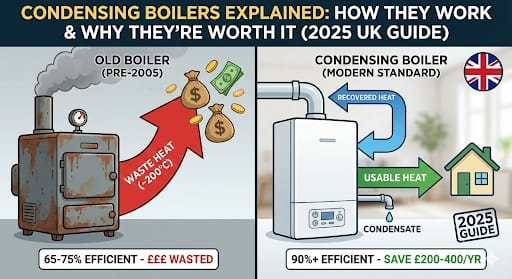
If you’re still running an old boiler installed before 2005, you’re essentially burning £200-400 every year for absolutely nothing. That money’s literally going up in smoke through your flue at 200°C, warming the atmosphere instead of your home.
This is exactly why condensing boilers became mandatory in 2005. But here’s something most people don’t know: just having a condensing boiler doesn’t automatically mean you’re getting those promised savings. Many homeowners with “efficient” boilers are still wasting money because their system isn’t set up properly.
This guide will show you how condensing boilers actually work, why they’re revolutionary, and most importantly, how to make sure yours is delivering the 90%+ efficiency you’re paying for.
What is a Condensing Boiler?
A condensing boiler is a gas boiler that recovers heat from waste gases that old boilers simply threw away.
Here’s the simple version: when gas burns, it creates water vapour containing loads of trapped heat energy. Old boilers sent this vapour straight up the flue at around 200°C, total waste. Condensing boilers cool these gases down until the vapour turns back into liquid water (that’s the “condensing” part), which releases that trapped heat.
The result? Condensing boilers achieve 90%+ efficiency compared to 65-75% from old models. That 15-25% difference translates to £200-400 annual savings for a typical three-bedroom home.
Since April 2005, UK law requires all new gas boilers to be condensing models with at least an A-rating. There’s no going back, and that’s a good thing for your wallet and the planet.
The Problem With Old Boilers (Why They Waste Your Money)
Imagine paying for a £100 tank of petrol, then immediately pouring £25-35 of it onto the road. That’s exactly what old non-condensing boilers do with your gas bill.
When gas burns, it heats water brilliantly but also creates exhaust gases containing water vapor. In old boilers, these gases shoot up the flue at temperatures around 200°C. All that heat represents energy you’ve paid for but never got to use.
For a typical home using 15,000 kWh of gas annually, an old 70% efficient boiler wastes 4,500 kWh. At current gas prices, that’s roughly £300-400 thrown away every year. Over 15 years, you’re looking at £4,500-6,000 in wasted energy.
The government recognised this massive waste and acted. In 2005, Building Regulations required all newly installed gas boilers to be condensing models. This wasn’t just about saving money domestic heating accounts for roughly 40% of UK carbon emissions. Making every new boiler 20-25% more efficient was one of the easiest wins in the fight against climate change.
How Condensing Boilers Solve the Waste Problem
The genius of condensing technology is embarrassingly simple: cool down those waste gases before they leave.
When water vapor cools below approximately 55°C, it condenses back into liquid water. This phase change releases “latent heat” the energy that was keeping the water as vapor.
Condensing boilers have a second heat exchanger specifically designed to cool flue gases below this 55°C threshold. As the vapor condenses, it releases its heat into the water returning from your radiators, preheating it before it goes back to the main heat exchanger.
Here’s what happens inside your boiler:
- Stage 1 Primary Heating: Gas ignites, creating a flame that heats water through the primary heat exchanger. Hot water gets pumped around your radiators. This is identical to non-condensing boilers.
- Stage 2 Vapor Condensation: Instead of going straight up the flue, exhaust gases pass through a secondary heat exchanger sitting in the path of cool returning water (typically 40-60°C). The gases cool dramatically, water vapor condenses into liquid droplets, releasing latent heat that warms the returning water. The now-cooled gases exit at just 40-60°C instead of 200°C.
That 140-160°C temperature difference represents recovered energy now heating your home. This is why condensing boilers achieve 90%+ efficiency while old ones maxed out around 75%.
The Condensate: What It Is and Where It Goes
Every hour your boiler runs, it produces roughly 2 liters of condensate per 30kW of output. For a typical 24kW boiler running six hours daily in winter, that’s about 300 liters per month.
This slightly acidic water (pH 3-5, like orange juice) needs to drain away. That’s why every condensing boiler has a small white or grey plastic pipe (usually 21-32mm diameter) leading to a drain most connect to your internal waste pipes, while some run externally.
Winter Problem: Frozen Condensate Pipes
This is the most common winter boiler problem in the UK. When temperatures drop below freezing, external condensate pipes can freeze solid, blocking drainage and shutting down your boiler.
Quick fix:
- Locate the frozen section (usually the most exposed external part)
- Pour warm (NOT boiling) water over it using a watering can
- You’ll hear gurgling as ice melts
- Reset your boiler once water flows freely
Prevention: Buy £5 of foam pipe insulation from any DIY store and wrap the entire external length. This simple step prevents most winter callouts.
For error codes related to frozen pipes, check our boiler error codes guide.
The Dirty Secret: Most Condensing Boilers Don’t Actually Condense
Here’s something the industry doesn’t shout about: studies show many “90% efficient” condensing boilers only achieve 75-85% efficiency in real homes.
A 12-month Energy Saving Trust study found that A-rated condensing combi boilers achieved just 83% average efficiency in UK households. That’s nowhere near the promised 90%+.
Why? Because most installers set them up to run exactly like old non-condensing boilers at 70-80°C flow temperatures with basic on/off controls. At these temperatures, very little condensing actually happens.
Remember that magic 55°C number? Your boiler only condenses when return water temperature is below this. If you’re sending water out at 75°C and it returns at 65°C, you’re above the threshold. No condensing = wasted potential.
Three Reasons Your Boiler Isn’t Reaching Its Potential
Reason 1: Your Boiler Is Oversized
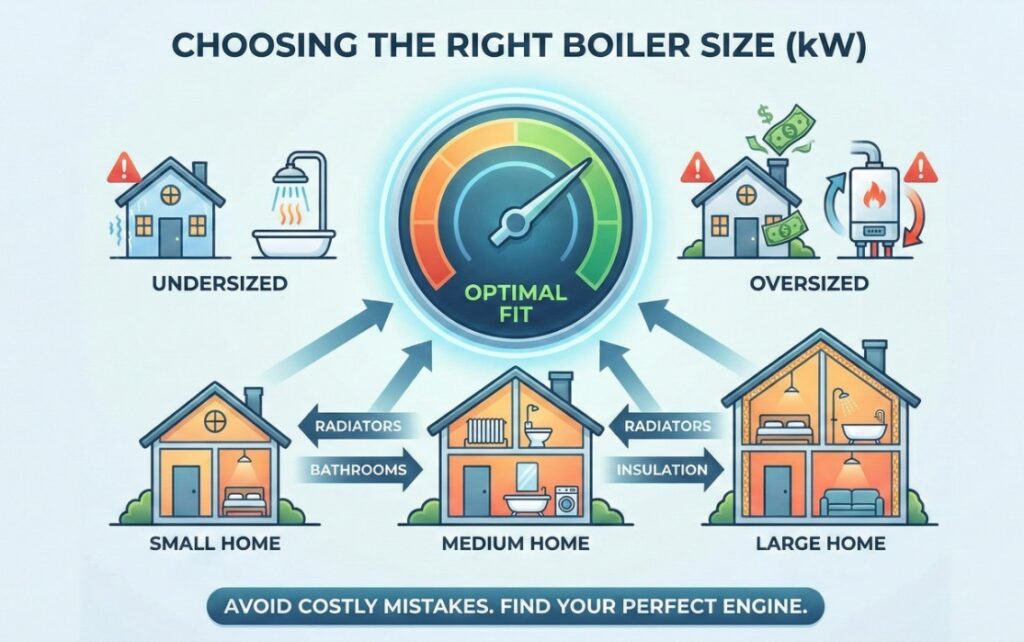
The average UK home needs about 6kW of heat on the coldest day. Yet most have 24-30kW boilers fitted. Oversized boilers fire up at 70% of maximum output, quickly overheat the system, then shut off. This constant cycling keeps water temperatures too high for condensing.
Reason 2: Flow Temperature Set Too High
Most boilers get set to run at 70-75°C. But for condensing operation, you want 60-65°C maximum for radiators. At 75°C flow, your return temperature is around 60-65°C too high for condensing. Drop flow to 65°C, and return might be 50-55°C, enabling proper condensing.
Reason 3: Basic On/Off Controls
A simple thermostat just tells the boiler “on” or “off,” causing temperature overshoot. Better controls (weather compensation, modulating thermostats) tell the boiler to reduce output gradually. The boiler runs continuously at lower output, maintaining ideal condensing temperatures.
How to Tell If Your Boiler Is Actually Condensing
The Flue Test
Walk outside and look at your boiler’s flue terminal.
If you see: Almost invisible exhaust, maybe a slight shimmer
This means: Your boiler IS condensing properly
If you see: Big white plumes of steam
This means: Your boiler is NOT condensing those are hot gases (100°C+)
It’s counterintuitive, but efficient condensing boilers have nearly invisible flue exhaust because they’ve already recovered the heat inside.
Your Energy Bills Don’t Lie
If you replaced an old boiler with a condensing one and your gas bills haven’t dropped by at least 15-20%, your condensing boiler probably isn’t condensing properly.
Expected savings: 20-25% reduction in gas usage. For a home using 15,000 kWh annually, that’s £200-350 saved.
Maximising Your Condensing Boiler’s Performance
Fix 1: Lower Your Flow Temperature
This is the single biggest efficiency improvement, and it costs nothing.
How to adjust:
- Find the flow temperature setting on your boiler
- Drop it by 5°C and run heating for a week
- If your home stays warm enough, drop another 5°C
- Keep going until you find the lowest temperature that keeps you comfortable
Target: 60-65°C for standard radiators, 50-55°C for oversized radiators
Note: If radiators are old and small, you might need to add or upgrade radiators. Our boiler installation team can assess your system.
Fix 2: Upgrade Your Controls
Weather compensation (outdoor sensor adjusts boiler temperature automatically) improves efficiency by 8-12%. When it’s mild, the boiler runs cooler. When it’s freezing, it runs hotter. This keeps return temperatures optimal for condensing.
Smart thermostats that support modulation also help they tell the boiler to reduce output gradually rather than cycling on/off.
Fix 3: Balance Your Radiators
Balancing ensures water releases about 20°C of heat as it passes through radiators. Unbalanced systems create hot return water that prevents condensing.
Quick balancing:
- Find radiators that heat up fastest
- Partially close the lockshield valve on these radiators
- This forces more water to slower radiators
- Aim for all radiators reaching temperature within 10-15 minutes
If you’re not confident, our boiler servicing includes system balancing.
Fix 4: Annual Servicing
A condensing boiler needs annual servicing to maintain peak efficiency. Engineers should:
- Perform combustion analysis
- Check return temperatures
- Clean the secondary heat exchanger
- Clean the condensate trap
- Verify modulation is working
Skipping servicing costs more than the £80-120 fee. Efficiency drops 2-4% annually without maintenance that’s £100-200 wasted over five years.
Different Types of Condensing Boilers
Condensing Combi Boilers
Combis provide both heating and instant hot water from one unit, with no separate tank needed.
Best for: Flats and houses with 1-3 bedrooms and one bathroom
Note: Combis need higher output for strong hot water flow, which can push them above ideal size for heating alone, making consistent condensing trickier.
Condensing System Boilers
System boilers work with a separate hot water cylinder. They often achieve better efficiency because the boiler can run at lower, steadier outputs.
Best for: Larger homes with 3+ bedrooms and multiple bathrooms
The Confusion: Combi vs Condensing
Condensing = how efficiently the boiler captures heat
Combi = the type of system (instant hot water, no tank)
All modern boilers since 2005 are condensing, whether combi, system, or regular. The condensing technology works the same in all types.
For more details, see our boiler installation guide.
Real-World Efficiency: What to Actually Expect
With optimal setup (88-92%): Correctly sized boiler, 60-65°C flow temperature, weather compensation controls, balanced system. Maybe 20-30% of UK homes achieve this.
With standard setup (82-88%): Most UK homes. Flow temperature 70°C, basic controls, slight oversizing. Still better than old boilers but leaving money on the table.
With poor setup (75-82%): Severely oversized, 75-80°C flow temperatures, never actually condensing. Barely better than old non-condensing models.
The Money Question: Are Condensing Boilers Worth It?
Annual Savings
Replacing a 70% efficient boiler with a properly set-up 90% condensing boiler:
Small home (10,000 kWh annual): Save £140-180/year
Medium home (15,000 kWh annual): Save £210-270/year
Large home (20,000 kWh annual): Save £280-360/year
Over a 15-year boiler lifespan, these savings total £2,100-5,400. The boiler pays for itself through efficiency alone.
For pricing details, see our boiler cost guide.
The Carbon Savings
That 2,000-4,000 kWh reduction equals:
- Small home: 370-740 kg CO₂ saved annually
- Medium home: 555-1,110 kg CO₂ saved annually
- Large home: 740-1,480 kg CO₂ saved annually
Across the UK’s 27 million homes, condensing boiler adoption has eliminated approximately 16 million tonnes of CO₂ annually since 2005.
Common Problems & Quick Solutions
Frozen Condensate Lockout: Pour warm water over frozen pipe section, reset boiler. Prevent by insulating pipe.
Kettling Noise: Limescale buildup on heat exchanger. Needs chemical descaler or power flush.
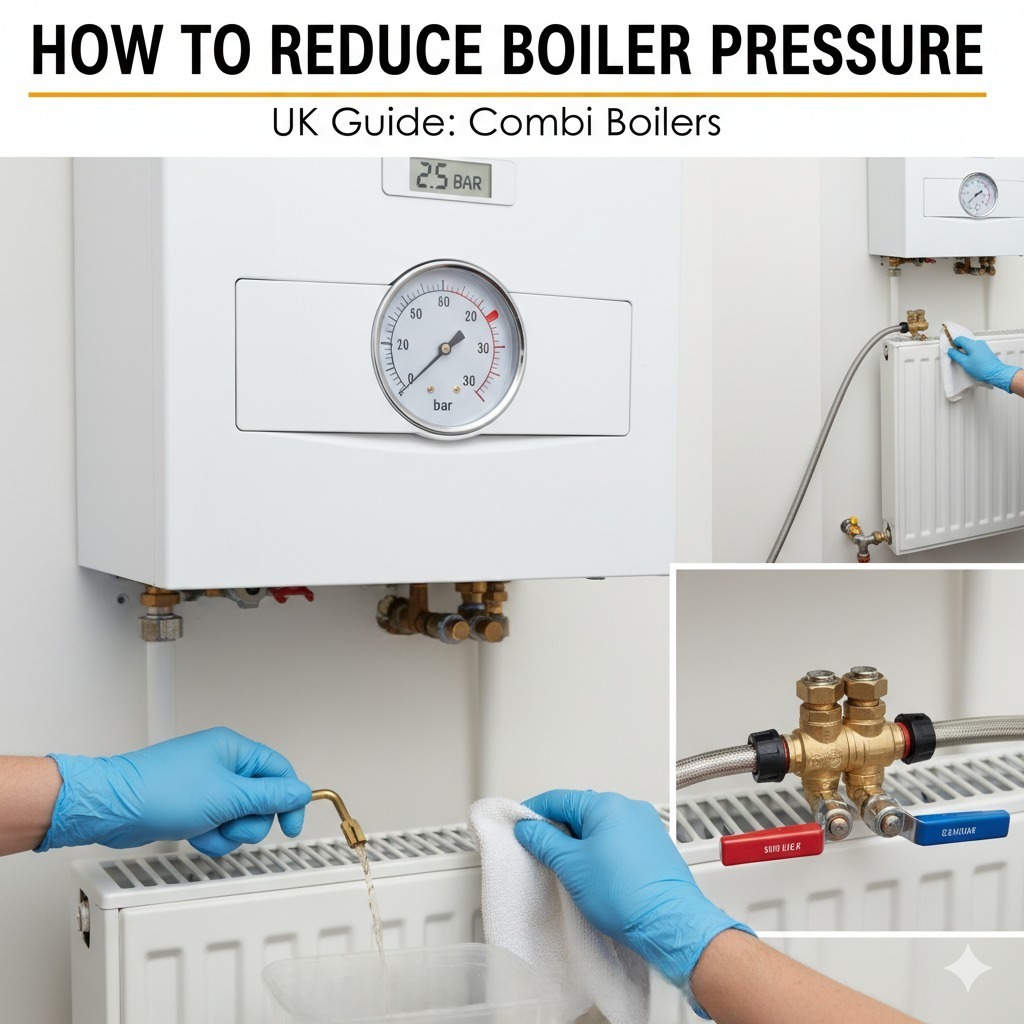
Pressure Drops: Check for leaks, verify condensate draining freely. See our boiler pressure guide.
Error Codes: Common condensing-related codes include EA/F28/L2 (often frozen condensate). Full breakdown in our error codes guide.
For persistent problems, contact our boiler repair team in Slough.
Your Condensing Boiler Action Plan
If You’re Buying New
Key questions for installers:
- Will you perform a heat loss calculation to correctly size the boiler?
- What flow temperature will it be set to?
- What controls are included?
- Will the system be balanced?
- How will the condensate pipe be routed and insulated?
Red flags:
- “We always fit 35kW combis for safety”
- No heat loss calculation mentioned
- Basic timer and thermostat only
If You Have One Already
Quick wins:
- Lower flow temperature by 5°C increments
- Insulate external condensate pipe
- Check flue exhaust should be nearly invisible
- Book annual service if overdue
If Bills Haven’t Dropped
- Check flow temperature setting
- Observe flue exhaust (white plumes = not condensing)
- Consider controls upgrade
- Get second opinion on boiler sizing
- Book professional commissioning check
The Bottom Line
Condensing boilers can achieve 90%+ efficiency by capturing heat that old boilers wasted, typically saving £200-400 annually while significantly reducing carbon emissions.
But simply having a condensing boiler doesn’t guarantee these savings. Flow temperature, controls, correct sizing, and proper balancing determine whether your boiler actually condenses or just pretends to.
The good news? If you already have an underperforming condensing boiler, you can often unlock its potential without replacement. Lower the flow temperature, upgrade controls, balance the system, and you might jump from 80% to 90% efficiency that’s real money back in your pocket.
Condensing boilers are absolutely worth it when installed and set up correctly. Don’t settle for a boiler that’s only pretending to condense.
Get Expert Help With Your Condensing Boiler
At ZR Heatings, we properly size, commission, and optimise every installation to deliver the efficiency you’re paying for.
Our services include:
- Professional boiler installation with heat loss calculations and proper sizing
- System optimisation for existing condensing boilers
- Annual servicing with combustion analysis and efficiency checks
- Emergency repairs, including frozen condensate pipe callouts
Serving Slough, Windsor, Maidenhead, and surrounding Berkshire areas.
Don’t leave efficiency to chance. Contact us today for a properly installed, correctly commissioned condensing boiler that actually delivers 90%+ efficiency.

how to bleed radiators correctly
Radiators Not Heating Properly


Signs Your Boiler Needs Repair
Condensing Boilers Explained: How They Work and Why They’re Worth It
Choosing the Right Boiler Size (kW) for Your Home


How to Read Your Boiler Display Codes
How Much Does a New Boiler Cost in the UK? (2025 Pricing Guide)
How to Choose Between Gas, Electric, and Oil Heating Systems