 Skip to content
Choosing the Right Boiler Size (kW) for Your Home
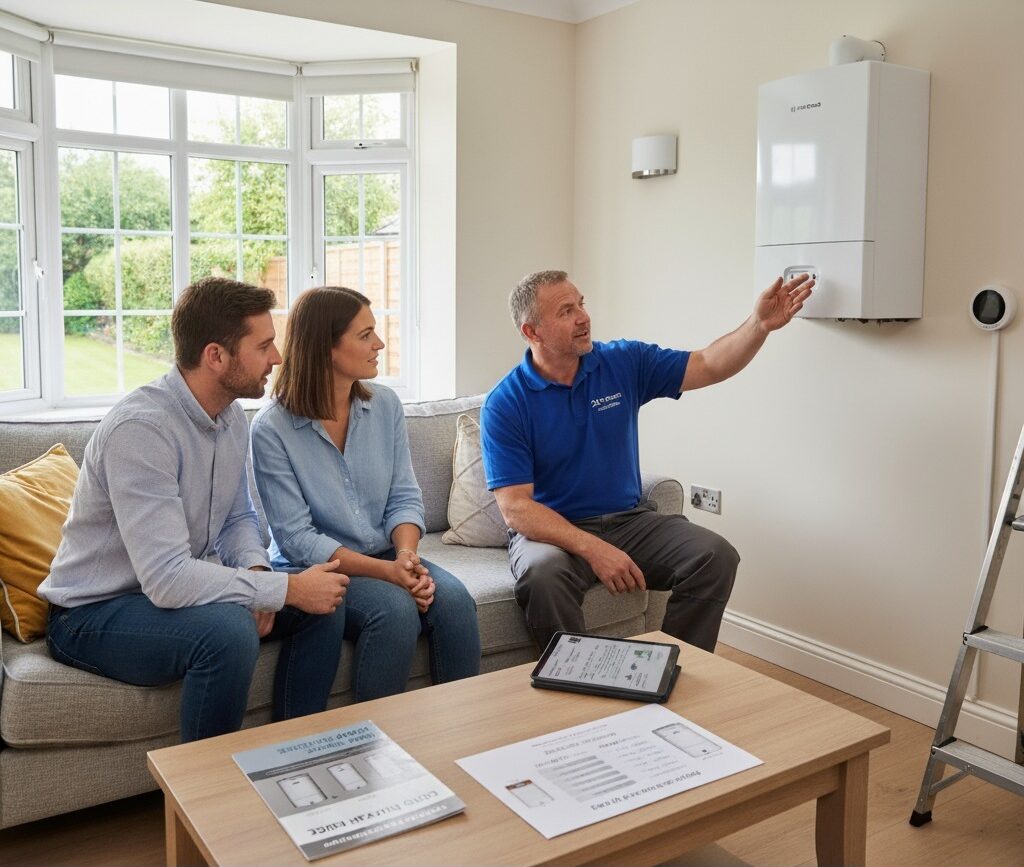
Choosing the right boiler isn’t just about picking a brand. It’s about finding the perfect engine for your home’s heating system. Get the size wrong measured in kilowatts (kW) and you could face years of higher bills, chilly rooms, and frustrating hot water problems. But get it right, and you’ll enjoy a warm, comfortable home that runs efficiently and cost-effectively for its whole lifespan. Let’s make sure you choose wisely.
ZR Heatings, with over 15 years of experience in the heating industry, we have seen the costly mistakes that happen when boiler sizing is guessed. This guide is designed to help you avoid them.
What Does Boiler Size (kW Output) Really Mean?
First things first: “boiler size” has almost nothing to do with its physical dimensions. When we talk about size here, we mean its power output, its ability to heat your home and water. Think of it like a car’s engine: a 1-litre and a 2-litre engine are different sizes, not necessarily under the bonnet.
kW Explained: Heat Output vs. Physical Size
A kilowatt (kW) is a unit of power. For boilers, it tells you how much heat it can create every second. A 30kW boiler can produce 30 kilojoules of heat energy every second. The higher the kW, the more heat it can pump out to warm up radiators and hot water.
How Boiler Power Relates to Heating + Hot Water Demand
Your boiler’s job is two-fold: heat your radiators and heat your water. The total kW rating you need is the sum of what’s required for both tasks at the same time. If your home needs 15kW to stay warm on the coldest day, and your shower needs 10kW of energy to deliver a hot, powerful flow, you’d be looking at a boiler of at least 25kW.
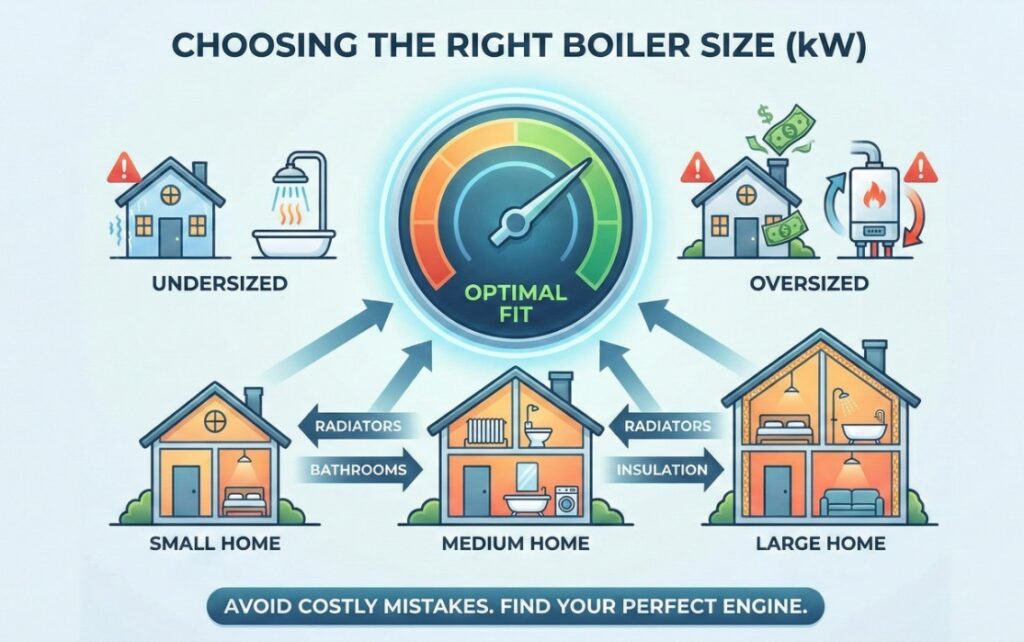
Why Oversizing or Undersizing Causes Problems
This is the core of the issue. Bigger is not better.
An oversized boiler (too many kW) will:
- Short-cycle: Constantly turn on and off quickly to meet small demands, wearing itself out faster.
- Waste energy and money: Each start-up is inefficient, burning extra gas.
- Provide poor comfort: Can lead to temperature swings in your home.
An undersized boiler (too few kW) will:
- Struggle to heat your home: It will run constantly but never quite get the rooms warm in winter.
- Provide poor hot water flow: Trickling showers and slow-filling baths.
- Work itself to death: Constant max output stresses components, leading to breakdowns.
Key Factors That Determine the Right Boiler Size
So, how do you find your Goldilocks boiler, the one that’s just right? These are the main things to consider.
- Number of Bedrooms: A good proxy for overall home size and how many people live there.
- Number of Bathrooms / Hot Water Outlets: More bathrooms mean a higher chance of multiple hot water demands at once (shower + kitchen tap).
- Number of Radiators: Each radiator gives off heat (kW). More radiators = more total heat demand.
- Home Insulation & Heat Loss: A well-insulated modern home traps heat. A draughty older home loses it quickly, requiring a more powerful boiler to compensate.
- Property Type: A mid-terrace house loses less heat through its shared walls than a detached house, which is exposed on all sides.
- Hot Water Usage Habits: A family of four taking morning showers needs more simultaneous hot water than a couple living alone.
Boiler Size by Boiler Type (Combi, System, Regular)
This is critical. The type of boiler you have changes how its kW power is used.
Combi Boilers (kW for hot water + heating)
Combis heat water directly from the mains, so their kW rating must be high enough for a great shower while also heating the radiators. Power is split between the two.
- 24–27 kW: Ideal for 1-2 bed flats or small homes with 1 bathroom.
- 28–34 kW: The sweet spot for most 3-4 bedroom homes with 1-2 bathrooms.
- 35–42 kW: For larger 4+ bed homes with 2+ bathrooms, or homes wanting high-flow showers.
System Boilers (kW for heating only)
These work with a hot water cylinder. The boiler’s kW is dedicated to heating your radiators and reheating the stored water in the cylinder. Hot water flow is determined by the cylinder and your water pressure, not the boiler’s instantaneous power.
- 12–18 kW: For smaller homes with a modest number of radiators.
- 18–24 kW: For medium-sized homes.
- 24–30 kW+: For larger properties.
Regular (Heat-Only) Boilers
Similar to system boilers (they also use a cylinder), these are often found in older homes with traditional heating systems and a cold water tank in the loft.
- 12–18 kW: Smaller traditional homes.
- 18–30 kW+: Larger period properties.
Quick Boiler Size Guide (kW Range by Home Size)
Here’s a straightforward starting point. Remember, this is a guide, not a definitive rule.
- Flats & Small Homes (1–2 bedrooms):
- Combi: 24–27 kW
- System/Regular: 12–15 kW
- Medium Homes (3–4 bedrooms):
- Combi: 28–34 kW
- System/Regular: 15–24 kW
- Large Homes (4–6 bedrooms):
- Combi: 35–42 kW
- System/Regular: 24–35 kW
- Very Large Homes or Properties With 3+ Bathrooms:
- A system or regular boiler with a large unvented cylinder is often best. A combi is usually not recommended here.
How Radiator Count Affects Boiler Size
Each radiator in your home gives off heat (measured in kW). Add them all up, and you have a big part of your total heating demand.
A very rough rule of thumb: Number of radiators x 1.5 kW.
- Example: A home with 10 radiators might need a boiler with at least 15kW just for heating.
- Adjustments: Large double radiators or towel rails in big bathrooms give off more heat (2-3kW+). Modern underfloor heating is very efficient and may need less kW per square metre than a radiator.
How Insulation & Heat Loss Influence Boiler Size
Insulation is your boiler’s best friend. It lowers the demand placed on it.
Factors that increase heat loss (meaning you might need a more powerful boiler):
- Old, single-glazed windows
- An uninsulated or poorly insulated loft
- Solid, uninsulated walls
- The property is north-facing or exposed
Your EPC (Energy Performance Certificate) rating matters. A home rated C or above is well-insulated. A D or below likely loses heat faster, pushing your boiler size requirement up.
Hot Water Flow Rate vs Boiler kW (Combi Only)
For combi boilers, kW directly equals hot water performance. The higher the kW, the better the flow rate (litres per minute, L/min) of piping hot water.
- A good shower needs about 9-12 L/min.
- A 24-27kW combi might deliver 9-11 L/min.
- A 35kW+ combi can deliver 14-15 L/min or more.
If you have two bathrooms and someone might shower while the dishwasher is on, you need a high kW combi to maintain good flow.
How to Calculate Boiler Size (Easy Step-by-Step Method)
- Count radiators: Multiply by 1.5kW for a base heating demand.
- Check bathrooms: 1 bathroom? A medium kW combi works. 2+ with possible simultaneous use? Lean towards a higher kW combi or a system boiler.
- Evaluate insulation: Old, draughty property? Add 3-5kW to your radiator total. New-build or recently refurbished? You might be fine with the base figure.
- Choose boiler type: Decide between combi, system, or regular based on your home’s setup and water pressure.
- Add a small safety margin: Round up to the nearest common boiler size, but avoid the temptation to oversize dramatically.
For a more precise figure, you can use a boiler manufacturer’s sizing calculator, like the one from Worcester Bosch.
Signs Your Current Boiler Is the Wrong Size
- Constant cycling: It fires up for a few minutes, turns off, then repeats all day.
- Poor hot water flow: Especially noticeable in winter when the boiler is also heating the house.
- Struggling in winter: Can’t get the house to a comfortable temperature on colder days.
- High gas bills: It’s working inefficiently.
- Uneven heating: Some radiators get hot, others stay lukewarm.
Example Scenarios
- 2-bed flat, 5 radiators, 1 bathroom: Well-insulated. A 24-27kW combi is perfect.
- 3-bed semi, 10 radiators, 1 bathroom: Decent insulation. A 28-30kW combi or an 18kW system boiler would work.
- 4-bed detached, 12 radiators, 2 bathrooms: Family of five. A 35-40kW combi (for flow) or a 24kW system boiler with a cylinder.
- 5-bed house, 15 radiators, 3 bathrooms: High demand. A 30kW+ system boiler with a large unvented cylinder is the recommended solution.
When You Need a Heat Loss Survey
For standard homes, the guides above are helpful. But in some cases, a professional Heat Loss Survey is essential. An engineer will calculate the exact kW requirement room-by-room.
Consider one for:
- Very large or unusual properties.
- Homes with significant extensions.
- Properties with complex heating like underfloor heating throughout.
- Homes with a very low EPC rating (F or G).
Final Boiler Size (kW) Selection Map
Home Size | Typical Radiators | Bathrooms | Recommended Boiler Type | Recommended kW Range |
Small (Flat) | 5-8 | 1 | Combi | 24-27 kW |
Medium (3-4 bed) | 8-12 | 1-2 | Combi | 28-34 kW |
Large (4-5 bed) | 12-18 | 2-3 | Combi or System | Combi: 35-42 kW System: 24-30 kW |
Very Large | 18+ | 3+ | System | 30 kW + large cylinder |
FAQs
Q: How does insulation affect boiler size?
A: Poor insulation increases heat loss, meaning you may need a more powerful boiler to compensate.
Q: What’s the difference between kW for combi vs system boilers?
A: Combi kW covers heating + instant hot water; system boiler kW is primarily for heating (hot water comes from a cylinder).
Q: Can I calculate boiler size myself?
A: You can estimate using radiator counts and bathroom numbers, but a professional heat loss survey is most accurate.
Q: Why does my boiler keep turning on and off?
A: It’s likely oversized (short-cycling) or has another fault – common in wrongly sized installations.
Q: What flow rate do I need for a good shower?
A: A good shower requires 9-12 litres per minute, which typically needs at least a 24-27kW combi boiler.
Need Help Choosing the Perfect Boiler Size?
This guide arms you with the knowledge to have an informed conversation. However, the final decision should always be made with a qualified, Gas Safe-registered heating engineer. They can assess your specific property, habits, and existing system to recommend the perfect model and size for long-term efficiency and comfort.
Ready to find your ideal boiler? Get in touch for a no-obligation consultation or a detailed heat loss survey to ensure your new boiler is the perfect fit for your home.

how to bleed radiators correctly
Radiators Not Heating Properly


Signs Your Boiler Needs Repair
Condensing Boilers Explained: How They Work and Why They’re Worth It
Choosing the Right Boiler Size (kW) for Your Home


How to Read Your Boiler Display Codes
How Much Does a New Boiler Cost in the UK? (2025 Pricing Guide)
How to Choose Between Gas, Electric, and Oil Heating Systems



I like how you clarified that boiler size is really about heat output rather than physical dimensions — a point that’s surprisingly easy for homeowners to misunderstand. The example of balancing radiator demand with hot water needs also highlights why guessing the kW rating can lead to long-term inefficiencies. It definitely reinforces the value of taking a more calculated approach when planning a new system.
Thank you for that insightful comment! The kW vs physical size distinction is one of the most common misconceptions we encounter during consultations.
You’ve touched on something crucial: the long-term inefficiency cost of guessing. We’ve found that an undersized boiler typically costs homeowners an extra £150-200 annually in wasted gas (constantly running at maximum capacity), while an oversized one adds £100-150 through short-cycling losses. Over a 10-15 year boiler lifespan, that’s £1,500-3,000 literally burnt away.
The radiator demand calculation is fairly straightforward, but hot water requirements especially with modern high-flow showers and multiple bathrooms is where the real complexity lies. A family of four with typical usage habits needs completely different sizing than a couple who rarely use the bath.
This is precisely why proper heat loss calculations aren’t an optional luxury; they’re fundamental to getting value from your investment. At ZR Heatings, we treat sizing as the foundation of every installation, get this wrong and everything else suffers.
Thanks for engaging with the content so thoughtfully!
Best regards,
ZR Heatings